Opinion
Understanding SoftPOS growth starts with observing the boom in payment device innovation
Barry Levett
CEO
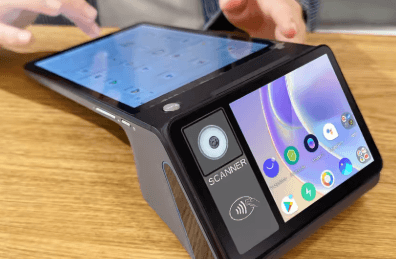
Last month, Mypinpad was on SUNMI's stand at EuroShop in Dusseldorf demonstrating our SDK and apps on a wide array of the Chinese innovator's SoftPOS-ready devices. SUNMI currently has the broadest range of SoftPOS-dedicated merchant devices capable of operating as contactless-only (via NFC/SoftPOS). It also offers fully featured PCI PTS-certified payment terminals (supporting chip, PIN, and contactless). We support both types of devices.
Consumerisation of merchant payment devices
What was notable was how traditional PTS terminals and contactless-only devices are all benefitting from the gradual 'consumerisation' of merchant payment devices. What do I mean by consumerisation? Essentially, merchants are beginning to choose payment devices based on how they fit into their stores' 'look and feel' – how they match their brand values and the customer experience they aspire to deliver.
If their brand values are tied to delivering stand out customer service, and they want to appear slick and modern, the old, wired PTS terminal 'bricks' which we've been used to using for the last 20+ years may now be eschewed. In will come the sorts of devices we've seen being provided by the likes of Clover, SumUp, Square and Dojo over the last few years.
There is an array of Chinese device manufacturers focusing on meeting this growing market demand for slicker PTS and dedicated SoftPOS-only contactless payment devices relying on NFC entirely. Very often now, it is hard to tell the difference between the two types. You can look out for the card slot on the front of the hardware. If it's not there, the device is contactless payments only.
Many markets now have ubiquitous contactless-enabled cards. In these markets, a SoftPOS designed 'terminal' is all you need. Sure, a retail store may still have one or two contact-enabled terminals to support chips, but the trend is to move to contactless-only in the majority of geographies. Retail POS systems in most markets have long supported the provision of payment information on printed receipts where necessary. As a result, we are now seeing the rapid disappearance of payment terminals with printers.
While manufacturers' BOM is reduced by stripping out receipt printers, EMV chip readers, embedded kernels, and extensive certifications from PTS terminals, manufacturers are often reinvesting these savings in better-looking hardware with larger screens and improved look and feel. Many of the new-style devices may actually be more expensive to build, but there seems to be a market for them.
Apple design benchmark
To a large extent, Apple is the device design benchmark for many merchant device manufacturers. We have witnessed the race between Apple and Samsung to sell phones that are faster, brighter, higher spec and more responsive. The result is that consumer expectations have extended beyond smart phones and tablets to in-store payment devices. And there is always the passive threat that Apple may enter their space and so payment device and POS manufacturers are incentivised to keep improving all aspects of their offerings. After all, Apple already provides wallet and payment acceptance functionality today.
For more on Apple's role in driving adoption of SoftPOS, do download our SoftPOS whitepaper now available free via our website. In terms of Mypinpad, we remain hardware-agnostic — looking to natively support Android, iOS and PTS devices, including providing hardware and services.
Slow switch to SoftPOS-only devices
Despite the allure of a larger variety of better-designed merchant devices, we don't think contactless-only devices will displace traditional PTS terminals any time soon. The two types of devices will co-exist for some years to come. Although I argued in my last blog that SoftPOS will see more rapid growth than many industry analysts have so far predicted, what is equally true is that the traditional PTS terminal market will see a slower decline than many also predict. This is not the 'rip and replace' story that many tech hardware markets have seen in the past.
This is because, overall, the number of payments-enabled devices will increase substantially, as larger stores will want to offer customers a range of options for paying according to different types of customer profiles and preferences. If you are a digital-only, mobile-first Gen Zer in a hurry, you are likely to go for the fastest option where you are fully in control. However, others looking for the 'human touch' may choose traditional lanes. Consumers expect choice, and it's now possible without merchants having to totally remodel their stores.
Device manufacturers are enabling even the largest merchants to take payments via an array of modern handheld and fixed devices. On the mobile side, digital tablets are being held by retail assistants walking the floor and supporting customers with finding products and pre-ordering for them. Meanwhile, shoppers are increasingly using portable scanners to keep an eye on their spending as they put items into their trolleys. Fairly soon, those same scanners will support self-checkout, thereby avoiding those groaning self-checkout queues at peak times.
New hardware running Android
The other trend we noticed at EuroShop was that the payments hardware world has consolidated around Android as the dominant operating system; many devices come with full GMS (Google Mobile Services) certification. PTS device manufacturers have long understood EMV Level 1 requirements governing hardware interactions between the terminal and the card. Notably, the schemes have looked to provide similar EMV Level 1 requirements for NFC on SoftPOS-designed devices — specifically, the ability to read cards reliably up to 4cm away. This is about giving that smooth 'tap-and-go' feel to consumers, without having to hunt for the reader.
Decluttering counter tops
Finally, SoftPOS merchant devices are likely to be favoured by merchants who are tired of keeping multiple devices to support multiple services, from Deliveroo or Uber Eats for food deliveries, to EVRi or Royal Mail for parcel deliveries. There is a growing trend towards having one single device to run them all, via an array of mobile apps. This would help merchants reclaim countertop space and help increase efficiency — improving the in-store customer experience. The SoftPOS ecosystem is geared towards enabling the APIs to ensure smooth toggling between booking and payment workflows on different apps, for example.
Summary
Our core observation at EuroShop is that the world of payment hardware is in good health, and both traditional PCI PTS-certified terminals and SoftPOS-dedicated merchant devices are set for strong growth. However, competitive pressures coming from the likes of SUNMI, Pax, Landy and Europo are forcing legacy giants such as Ingenico and Verifone to pivot their design strategies to compete with the sleekness, range and lower-cost models of a new breed of largely Chinese manufacturers. The results will be positive for merchants and their customers alike. The good news for manufacturers is that more devices than ever before will be deployed in stores as they seek to modernise as well as iteratively improve and differentiate customer experience.
Download our whitepaper on Mapping the Journey to Mainstream Adoption of SoftPOS
Talk to Us
Ready to explore what Mypinpad can do for you?
Certified. Independent. Deployed across 28 countries. Let's talk about your use case.
Get in Touch