Opinion
The rise of AI-generated deepfakes and agentic commerce together create the perfect storm for the rise of fraudulent payments
Barry Levett
CEO
Tap-to-authenticate offers a simple step for combatting heightened risk of fraud as the deepfake threat rises alongside adoption of agentic commerce.
However, there is one obvious authentication solution – your card. Let's take a closer look.
Back in February 2026, fraudsters reportedly used a combination of deep fakery and social engineering to extract around €95m from Fideuram, the private banking arm of Italy's Intesa Sanpaolo bank.
According to Reuters, the attack combined a WhatsApp message impersonating the banking group's chief executive, followed by a telephone call using an AI-cloned voice of a trusted senior lawyer, to dangerous effect:
How the fraud worked
1. Impersonation of the group CEO via WhatsApp
Paolo Molesini, then chairman of Fideuram, received a WhatsApp message, apparently from Carlo Messina, CEO of parent company Intesa Sanpaolo. It requested urgent assistance with a sensitive overseas financial transaction.
2. AI-generated voice supplied apparent confirmation
A subsequent telephone call purportedly came from Paolo Nastasi, a senior partner at international law firm A&O Shearman in Italy. According to Italian reporting, the voice was replicated using AI. Molesini knew the lawyer, making the apparent confirmation particularly convincing.
3. Legitimate finance personnel executed the transfers
Molesini instructed Fideuram's finance department to arrange multiple international transfers, principally to bank accounts in China and Hong Kong. The fraud therefore exploited genuine internal authority rather than compromising existing payment systems themselves.
4. Detection, recovery and investigation
Once the bank identified irregularities, international cooperation enabled approximately €40 million to be frozen or recovered in China and €13 million in Portugal. Most of the remainder was reportedly still unaccounted for, with funds believed to have been converted into cryptocurrency.
Molesini resigned in March 2026, citing personal reasons. Reuters reported that neither he nor other Fideuram executives were under investigation. Milan prosecutors were investigating a suspect outside Europe.
The incident offers a salutary warning for the emerging agentic commerce economy: recognising a familiar voice, name or digital identity is not the same as establishing legitimate authority to transact. As autonomous AI agents increasingly initiate purchases and payments on behalf of consumers and businesses, payment providers must authenticate not just the agent's identity, but the customer's underlying authorisation, the agent's delegated permissions and the integrity of each transaction.
Card schemes and standards bodies address the AI threat
Visa, Mastercard and the PCI Security Standards Council (PCI SSC) have all been working hard during the last two years on security enhancements to combat AI-generated fraud. For example, Visa has developed its Trusted Agent Protocol to combat potential fraud inside agentic commerce flows.
And just last month, Visa, BILL and Billtrust announced they have launched the first live pilot to enable trusted AI agents to initiate and complete approved buyer invoice payments end-to-end through supplier portals. Most payments made via portals today still rely on human authentication requirements that limit how approved payments could be automated.
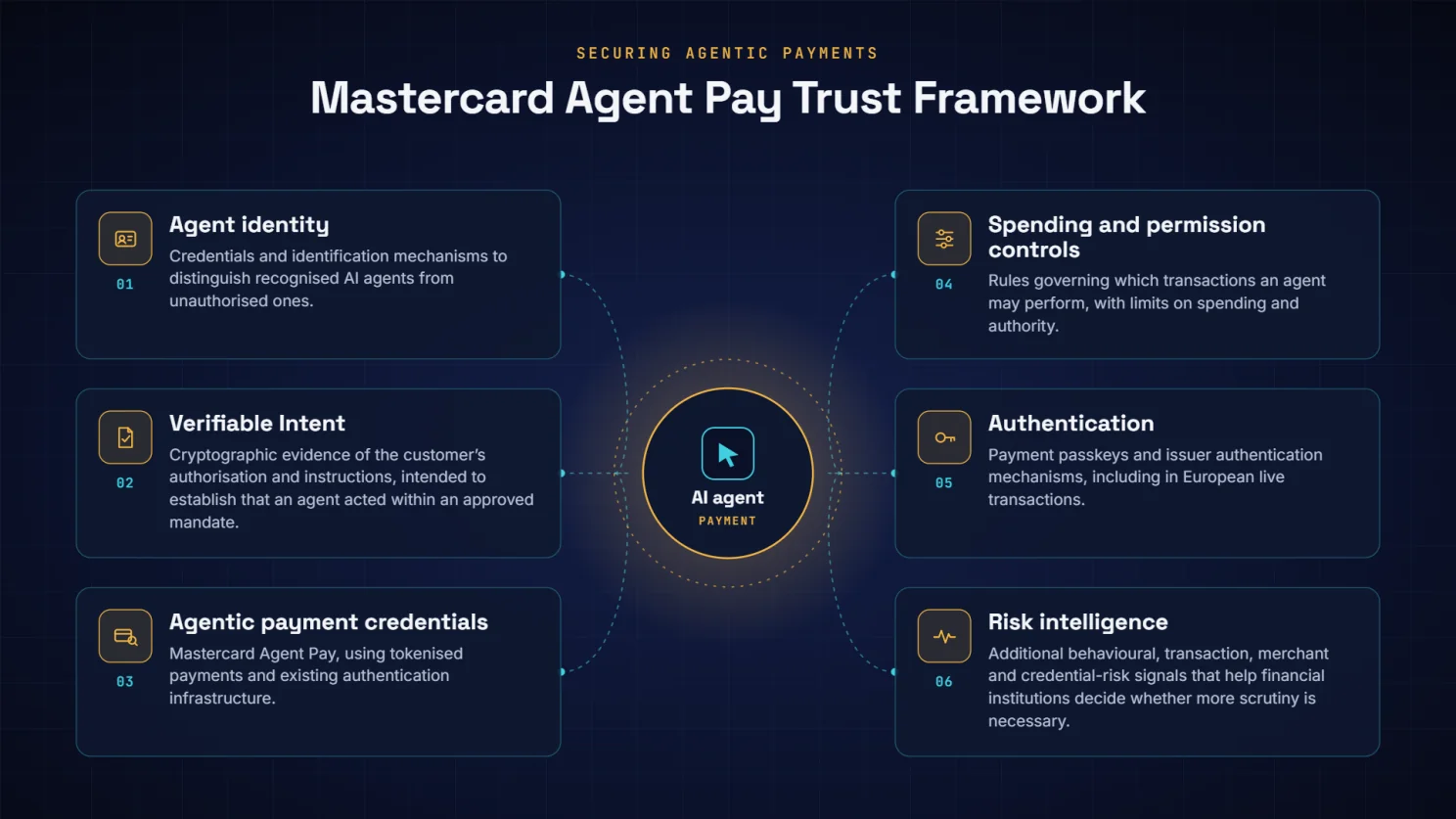
Mastercard seems to have gone further still with its five-pillar Agent Pay Trust Framework for agentic payments. Those five pillars are: Identity, Intent, Controls, Execution and Intelligence. Under the framework, Mastercard is introducing six protections:
Meanwhile, the PCI SSC came forward with its additional guidance for securing AI in payment environments, just last month:
The first principle is that AI systems must be deployed and managed in compliance with applicable PCI SSC requirements. Beyond that, in the PCI SSC's words, AI systems should not be:
1. Trusted with high-impact secrets or unprotected sensitive data
AI systems have been known to provide output that contains sensitive information, either without direct prompting or through specifically and maliciously formatted prompt input. Additionally, the data processing and flow of AI systems may not be fully contained or constrained within an entity’s control.
Examples of sensitive data that should be kept out of AI datasets include API access tokens and user credentials (that are not specific to that AI), unsecured account data, and cryptographic keys or key material.
2. Given agency to perform operations which require the formal acceptance of responsibility
It is important to remember that even with the increasing ability of AI, these systems are not human individuals, and they cannot accept or take on responsibility. Therefore, operations and roles which require the formal acceptance of responsibility are not suitable for AI systems. This includes roles such as key custodians (a role which is also prevented by the ‘no high-impact secrets’ principle above) and providing management-level authorisation or approvals.
3. Used to generate security-sensitive random or secret values
One situation where AI can be said to be just as good as humans is in generating random numbers and other unique, secret values. Both AI and humans are just as bad at ‘thinking up’ random values! It is often a challenge to determine if a value is truly random or not, and the recommendation is always to use a known-good random number generator (RNG), in a way that will keep the values that are generated secret and safe.
It may seem reasonable to have an AI system interface to such a known-good RNG where random values are required, but if the use is generating high-impact secrets (cryptographic keys, passwords, etc.), the use will violate the first ‘should not’ principle anyway. Of course, if the random values are not security sensitive, this principle may not apply.
4. Implemented with full agency over the creation and deployment process chain without a human-in-the-loop
An important concept in the use of AI systems is ensuring that there is a ‘human-in-the-loop’. This means that there should always be a human who is involved and responsible for the oversight of an end-to-end process. AI systems may be used to perform the individual actions to create, test, and deploy software. However, the whole creation and deployment pipeline should not be fully automated.
It is also important to understand that different AI systems may be trained or tuned to specific aspects of development. An AI system that is used to create software may not be specifically trained to create secure software.
5. Provided with access to systems and information not required for their operation
It can be tempting to give an AI system access to as many systems and as much information as possible, but this increases the potential impact if things go wrong or work in a way that was not expected.
Principles and protocols for keeping agentic commerce secure still leave one clear problem: we are attempting to use digital technology to control and manage digital payments. Very often, we are pitting AI security ‘bad’ exploit against ‘good’ AI security solution, leaving the inevitable question: ‘which one will win?’. A question with a very uncertain answer today.
Back to first principles of SCA
For decades, payment authentication has rested on three fundamental principles:
1. Something you know
2. Something you have, and
3. Something you are.
These principles remain embedded in European and UK Strong Customer Authentication (SCA) requirements, which normally demand at least two independent authentication factors.
However, the emergence of deepfake-enabled fraud and proliferation of autonomous AI purchasing agents raises an increasingly important question: is successfully authenticating a customer the same as establishing that a specific transaction is genuinely intended and authorised?
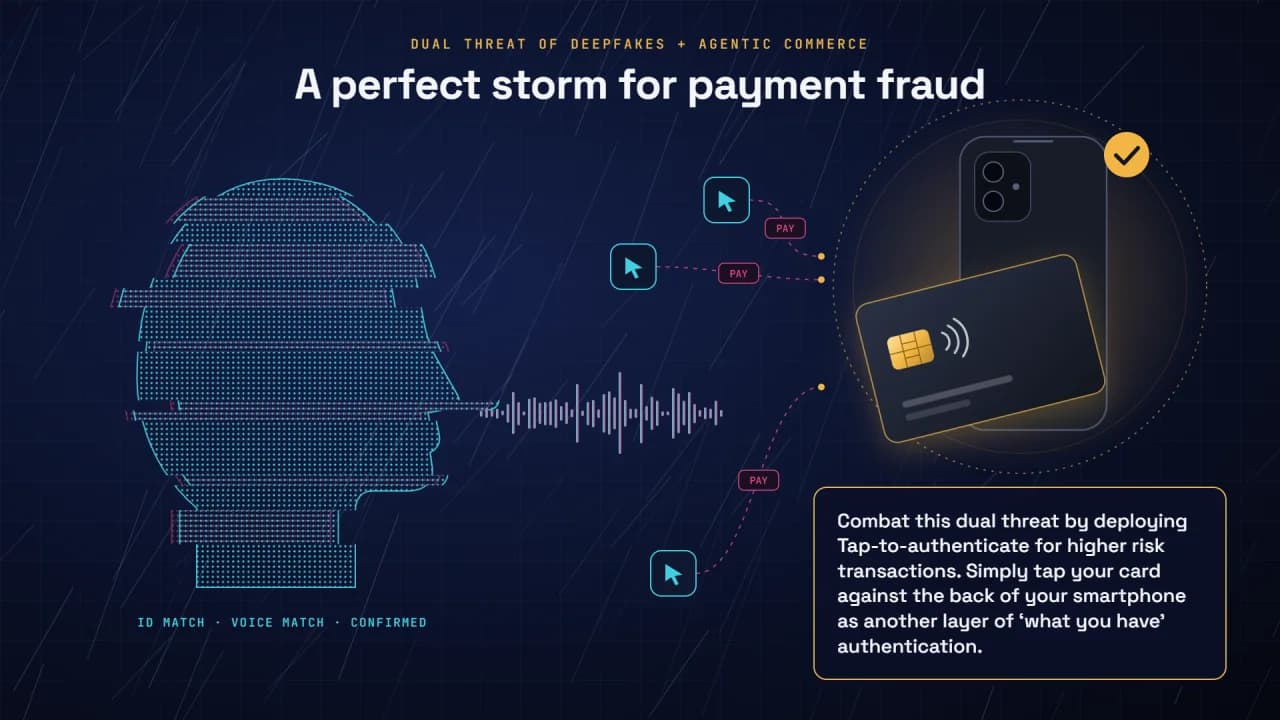
Showing physical card to your device
Now is the time to reintroduce another ‘something you have’ which is physical as that extra layer of authentication is now more likely to be needed in the AI age. A physical card, with EMV cryptographic key embedded within it, provides the ideal additional layer of security for larger, higher risk or unusual transactions. That card does not need to be your bank card per se. It could be a card dedicated to authentication alone. For example, it could be the one issued by your employer which enables you to access your place of work. That card might be issued by a physical security or access control company, for example.
Where fraud risk exceeds an agreed threshold, customers should be able to provide independent cryptographic proof of possession through their genuine EMV chip-enabled card of choice, alongside explicit verification of the transaction being approved.
The point is that in order to challenge AI-inspired threats, it is better to inject an additional layer of authentication which is based on something you physically have in your wallet, ‘out of band’ if you will.
In other words, it should be more than just another factor of digital authentication. As we have discovered, using two factor authentication (2FA) via your smart phone alone, the principles of 2FA can be undermined as user behaviour and technology changes.
2FA flows were inherently more secure when you logged into the provider’s payment portal via one device (normally your PC of old) and only used your mobile to receive a one off, time limited access code, which you duly typed into your PC to authenticate your access to pay a bill online.
However, as we all know, we all now invariably find ourselves starting and finishing a transaction on our mobile phone today. We authenticate many online payments by toggling between the supplier’s payment portal and our bank’s mobile app.
This is inherently less secure as it fails to take account of the fact that more than one person may be able to gain access to our phone. For example, my son frequently secretes my phone away, disables its auto-lock to bypass Apple’s face ID requirement, and has a look see.
Cooling off period
For the highest-risk payments, a temporary cooling-off period, like the one imposed in Singapore from last year, could introduce a further opportunity to detect deception before funds are released. Singapore's Monetary Authority, working with the Association of Banks in Singapore (ABS), introduced enhanced 24-hour ‘hold or reject’ safeguards from 15 October 2025 for all transactions equal to or over 50% of personal current or saving accounts balances with S$50,000 or more in them.
The triggering transaction and subsequent outgoing transactions can be held for 24 hours or rejected. This is documented in the ABS announcement dated 3 October 2025, covering DBS, OCBC, UOB, Citibank, HSBC, Maybank and Standard Chartered banks.
Singapore also operates separate 12-hour cooling-off periods for activities such as adding a new payee, increasing transfer limits and changing contact details. For example, DBS introduced these additional protections in March 2026. A cooling off period would have worked very well for Paolo Molesini at Fideuram.
Summary
It is clear that a combination of the rise of both deepfakes and agentic commerce demands tougher payments security for higher value, higher risk and/or non-regular transactions. This is as true for consumer as for business transactions.
Presenting an EMV chip-embedded card which is tied to you personally (by holding it to the back of your smart phone to read its chip), and the introduction of a cooling off period together seem like simple solutions which could be easily applied ubiquitously in support of the comprehensive security enhancements which are being introduced by card schemes and standards bodies alike as agentic commerce takes off.
Talk to Us
Ready to explore what Mypinpad can do for you?
Certified. Independent. Deployed across 28 countries. Let's talk about your use case.
Get in Touch