Opinion
Mobile wallet fee challenge points to a bigger, more positive quest for openness in payments
Apple appears to be caught in the cross hairs of issuers and regulators alike right now but this is a symptom of a much more significant and positive quest for greater openness, choice and resilience
For years, Apple Pay has been treated as one of the great success stories of mobile payments. It offers elegant design, high security, intuitiveness and an all-round great customer experience. Apple Pay took contactless mobile payments from novelty to the mainstream in a few short years. However, the payments world now must accommodate a wider mix of technology and rail providers. This ultimately means that all the giants of our market, including Apple, will increasingly need to support a more open, yet still highly secure payments ecosystem. Let’s dig a little deeper.
The US litigation is about wallet control, not just fee limitation
Apple is facing renewed scrutiny over the fees it charges card issuers when their cards are used through Apple Pay. In the US, payment card issuers have been given the green light to challenge those fees through antitrust litigation. Apple Pay’s fees are claimed to be 0.15% for credit card transactions and half a cent (0.5c) per debit card transaction today.
The current US challenge should be understood as part of a wider argument about control of mobile payments. The claim against Apple is that issuers paid fees they would not have had to pay in a properly competitive mobile wallet market. Android wallets have historically offered a useful comparison because issuers have not generally faced equivalent per-transaction wallet fees from them.
That distinction matters. It suggests the Apple Pay fee model is an avoidable feature of mobile payment security or tokenised contactless acceptance. The US case will turn on legal questions around market definition, monopoly power, causation and damages. However, strategically, the commercial question is simpler: if a card issuer cannot realistically reach iPhone users for tap-and-pay without Apple Pay, how much freedom does it really have?
Europe has already ruled that NFC access could not remain closed
In Europe, Apple has already been forced to open access to NFC for alternative mobile wallets on its iPhones. The European Commission’s concern was that Apple reserved NFC access on iPhones for Apple Pay, preventing rival mobile wallets from competing properly. And in July 2024 the EC accepted legally binding commitments from Apple to provide NFC access for free, using Host Card Emulation (HCE), within the EEA. That meant third party wallets in the EEA could access NFC in HCE mode, use relevant iPhone features, and be set as the user’s default payment app.
This has made a palpable difference in the EEA already - multiple apps from the likes of PayPal, Curve and Klarna have launched over the last two years using NFC. The opening up of NFC also established a key principle: Apple can no longer simply use control of the iPhone’s contactless interface to reserve mobile payments for Apple Pay alone.
The logical next question is whether access that is technically open, but commercially constrained, is enough. If access carries terms, pricing or technical limitations that make alternative wallets or SoftPOS models hard to deploy at scale, regulators may decide the market has not become meaningfully open.
The UK is following the same broad direction as the EC, but through the CMA
Meanwhile in the UK, the Competition & Markets Authority (CMA), and the Financial Conduct Authority (FCA) have all shown interest in how Big Tech wallets affect competition, innovation and payments choice.
In the UK, the key intervention route is likely to be competition-led rather than conventional financial conduct/payments regulation via the FCA. The CMA’s designation of Apple as having strategic market status in mobile platforms gives it a stronger basis to impose conduct requirements.
The CMA has already been examining NFC access on iOS, including the technical approach and the pricing of that access. The FCA also has an important role here because digital wallets are now part of the payments ecosystem. Their work has recognised that Apple Pay and Google Pay are major pass-through wallets and that digital wallet use has grown sharply. They have also recorded concerns that Apple’s control over iOS can affect the ability of issuers and competing wallet providers to innovate.
However, if the UK acts directly against Apple’s NFC restrictions or access terms, the CMA is the most likely front-line regulator. The practical result is still the same: the UK is unlikely to be comfortable with a long-term model in which one mobile platform controls the key access point for digital wallet competition. Choice engenders resilience as well as flexibility in payments.
Apple Pay’s success created the next competition problem
Apple Pay succeeded because it solved a real consumer problem. It made card payments on mobile phones feel simple, safe and native to the device. For issuers that created a dilemma. Their customers wanted Apple Pay. Merchants accepted it in droves. The experience was trusted. However on iOS, Apple controlled access to the relevant NFC functionality and controlled the Apple Wallet experience. Therefore card issuers had little realistic choice but to participate.
The issue is not simply that Apple charges a fee to manage its own payment gateway. After all, payment services cost money to build, certify, secure and maintain. The issue is whether those charges are kept in check by meaningful competition.
If alternative wallets, alternative NFC access models and alternative payment rails can compete fairly on iOS, then Apple Pay becomes one choice among several. If not, the fee becomes less like a market price and more like a toll on access to the iPhone user base.
Wero ratchets up the pressure on Apple in Europe
The rise of Wero gives the European debate on this topic a sharper edge. Wero is not just another wallet. It is part of Europe’s attempt to build a sovereign, account-to-account (A2A) payment alternative that can reduce dependence on international card schemes and Big Tech wallet layers. It has already launched in key European markets and is moving from person-to-person payments into a large number of e-commerce and in-store POS use cases based in the Benelux and France.
That matters for Apple because a pan-European wallet strategy cannot work properly if it is structurally disadvantaged on the dominant premium smartphone platform. If Europe wants Wero and other domestic A2A rails, instant payments and bank-led wallets to compete at the point of sale, it needs access to the same user experience elements that made Apple Pay so successful: NFC, default wallet settings, biometric authentication, double-click access and deep integration into the mobile experience.
In that sense, Wero is not separate from the Apple Pay fee debate. It is one reason the debate is becoming more urgent. Europe wants local rails and European payment propositions to scale. That is very hard if they sit behind a gate controlled by a US device ecosystem.
The quest for choice
It’s now too simplistic to present this as cards versus A2A payments, or Apple Pay versus Wero showdown. The real issue is choice for all participants from issuer to acquirer, and merchant to their customers.
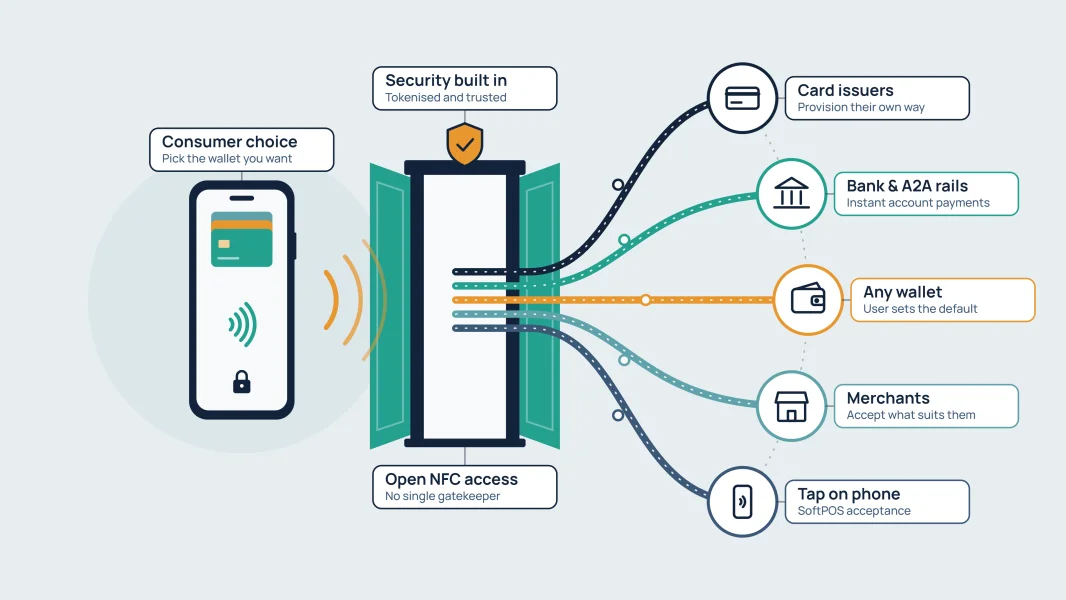
Consumers should be able to choose their preferred wallet. Issuers should be able to choose how they provision cards and credentials. Merchants should be able to support the payment methods that suit their economics and customer base. PSPs and acquirers should be able to build services across iOS and Android without unnecessary asymmetry. Domestic schemes and A2A rails should be able to compete on the quality of their proposition, not on whether a mobile operating system lets them reach the user.
This is particularly important as payments become more fragmented. A merchant may need to support cards, wallets, A2A payments, local schemes, instant payments, loyalty-linked payment experiences and emerging identity-based authentication methods. No single rail or wallet will dominate every use case. The future payments market therefore needs openness at the device layer.
Openness also matters for resilience
The strongest argument for openness is not only competition. It takes us back to the theme of my last blog – resilience. If merchants and consumers become over-dependent on one wallet, one device ecosystem, one card rail or one proprietary access model, the system becomes more brittle. Outages, commercial disputes, regulatory changes, fee increases or technical restrictions can then have wider market consequences.
A more open model allows PSPs, acquirers and merchants to route intelligently, support local alternatives, maintain fallback options and design payment journeys around the customer and the risk, rather than around the limits of a closed ecosystem.
That does not mean a free-for-all. Payments still require high standards of security, certification, authentication and fraud control. Openness must be paired with certification and compliance. But closed control is not the same thing as security. The better model is ‘certified openness’: access governed by clear technical, security and liability rules, but not locked behind one provider’s commercial priorities.
Why this matters for SoftPOS and software-based acceptance
The same principle applies to payment acceptance. If iOS and Android can support secure, certified payment and authentication experiences in a consistent way, PSPs and acquirers can offer merchants a much cleaner proposition. They can support cards, local rails, A2A payments, authentication services and value-added services across multiple devices and operating systems. That is the real prize. Not simply replacing the PTS terminal, but creating a more flexible and feature rich software-based acceptance layer.
For merchants, this means more choice over hardware, lower dependence on single-purpose terminals, and the ability to embed payments into staff devices, kiosks, scan-and-go systems, mobile POS, delivery devices and new customer journeys.
For PSPs and acquirers, it means the ability to build one service model across operating systems rather than stitching together separate Apple, Android and proprietary-terminal workarounds.
For consumers, it means greater choice of wallet and payment method without losing the convenience and security they have come to expect. It goes some way to explaining why in recent months we have been rolling out support for domestic and regional card and payment schemes including RuPay, JCB, UnionPay International and BankAxept, with BANCOMAT to follow. Choice and flexibility makes for both payments resilience and healthy market competition.
Openness by design
The Apple Pay fee challenge is not just about 15 basis points on credit transactions or half a cent on debit card transactions. Those numbers matter, especially to issuers operating under margin pressure but the bigger issue is control:
- Who controls the wallet?
- Who controls access to NFC?
- Who decides which payment rails get equal access to the customer?
- Who owns the authentication experience?
- Who gets to monetise the contactless interaction?
The answer cannot be a single device manufacturer, a single wallet, a single card rail or proprietary ecosystem. The future of payments will be more mixed, not less: international cards, local schemes, A2A rails, instant payments, bank wallets, Big Tech wallets, SoftPOS, Tap to Pay, loyalty-linked checkout and authentication-led services will all coexist.
That future demands openness by design. It needs consumers to have wallet choice, merchants to have rail choice, issuers to have fair access, and PSPs to have the ability to build secure, compliant services across devices and borders.
Apple Pay proved that mobile payments could become mainstream. The next phase needs to prove that mobile payments can become fully open - while remaining highly secure. The watchwords for future market success are security with flexibility, resilience and choice.
Talk to Us
Ready to explore what Mypinpad can do for you?
Certified. Independent. Deployed across 28 countries. Let's talk about your use case.
Get in Touch