Opinion
It is easy to underestimate the growth potential of SoftPOS
Barry Levett
CEO
This month, I've decided to explore SoftPOS' growth predictions as larger retailers are now considering ways to improve customer experience, exploring opportunities for queue busting via self-checkouts across convenience store estates, for example.
During January, we published our latest whitepaper entitled Mapping the Journey to Mainstream Adoption of SoftPOS. This 31-page paper makes a strong argument that, for those of you that are familiar with Geoffrey A Moore's seminal text on technology adoption called Crossing the Chasm, SoftPOS has clearly crossed that chasm into mainstream adoption.
This means that SoftPOS will see accelerated adoption over the next 10 years or more. We argued in our paper that three key barriers to mainstream adoption had been overcome in the last few years enabling that to happen.
One of those barriers was contactless payments growth worldwide. Another was the maturing of the PCI MPoC standards to version 1.1. However, the third, and arguably the most important in terms of widespread merchant adoption of SoftPOS, is improvements in hardware (not just mobile phones).
For many years, the industry has seen SoftPOS as a tool for the marginal SME merchant who could otherwise not afford 'proper' payment terminals, i.e. the PCI PTS (PIN Transaction Security) certified bricks occupying merchant desks the world over. 'Real merchants use terminals. SoftPOS has no place in larger merchants stores and definitely not in enterprise use cases', or so the mantra goes. However, when one considers the cost and workflow integration differentials, a very different picture emerges and this is what I'm exploring here.
The world of payments is now changing for merchants of all shapes and sizes, as well as for consumers themselves. This is no longer just about the market stall holder taking a few contactless payments via his phone when customers fail to bring cash. It is about enabling even the largest merchants to take payments via an array of modern handheld and fixed devices which are now finding their way onto shop floors across the world.
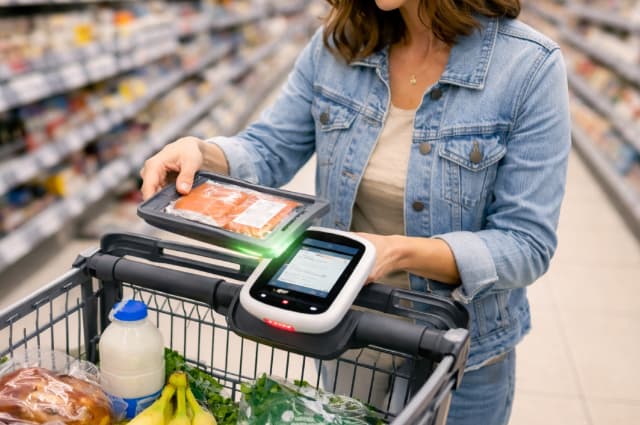
On the mobile side, digital tablets are being held by retail assistants walking the floor and being used to support customers with finding products and pre-ordering for them. Meanwhile, shoppers are increasingly using portable scanners themselves to keep an eye on their spending as they drop items into their trolley. And fairly soon those same scanners will enable you to self-checkout – thereby avoiding those groaning self-checkout queues at peak times.
On the fixed side, having payments taken through a PTS terminal introduces costs for many businesses. There are administrative costs for reconciliations; losses from errors in amounts entered; inflexible workflows; and valuable retail space taken up by bulky and ugly terminals. It would be much better for many businesses to have their POS system, which is fully integrated with ordering and inventory systems, to also act as the device for accepting payments, resulting in lower cost and higher flexibility for merchants and shoppers alike. This vision is now possible with SoftPOS, if paired with modern POS systems already coming to market.
For more than a decade, card acceptance has been constrained by hardware. PTS terminals had to be ordered, shipped, installed, maintained, tracked, reported on, and eventually replaced. Acquirers were obligated by the PCI to maintain a complete and accurate inventory of every PTS device they deploy.
Records of device models, their versions, serial numbers, PCI-PTS approval class and expiry dates, chain of custody records, device swaps, replacement and returns, and even secure destruction of devices, had to be auditable by PCI assessors, schemes and regulators. Monitoring, inspection and record retention requirements run for several pages.
Yet a simple analysis of Bill of Materials (BOM) for those PCI-PTS terminals, together with certification and evaluation fees combined with kernel and operating system maintenance fees, leads to a realisation that provisioning a PCI-PTS terminal costs up to $50 more per device, than devices which are payments-enabled via SoftPOS.
Whether these additional costs are overt and borne directly, or indirectly passed on by the payment service provider (PSP), merchants are anyway incurring costs that they need not carry today. Staying with the status quo means asking merchants to pay more for a less flexible product. Why would they do that?
The onerous nature of all this became evident last autumn with the reported problems the world over connected with the expiring PTS POI v5 terminal fleets and their inability to roll out new v5 terminals after 30 April 2026. This led to the PCI SCC stepping in to extend that deadline by one year. To quote PCI SSI's press release on this at the time:
"(This) extension is intended to support secure deployment continuity in the face of widespread ecosystem challenges, such as limited technician availability, constrained hardware supply, and complex upgrade timelines, particularly in embedded, unattended, and multi-component environments."
SoftPOS represents a potential break with that faltering model – giving the merchant the control and choice of which hardware to use as their payment terminal. So, the PSP can now come to the merchant and say: 'we have a SoftPOS-enabled terminal under this new rental agreement for you to sign' or they can instead say, 'Here is your new mobile app or SDK, and you now have the freedom to select the device of your choice' in much the same way as a mobile network operator like Vodafone offers its customers the option of having a SIM-only contract – paying them for 'airtime' and volume of data consumed on your own device which many now buy direct from the manufacturer.
SoftPOS offers a simpler, faster way to accept digital payments anywhere, with the same reliability as traditional terminals, while potentially reducing costs traditionally associated with PTS terminal provision. By reducing operating costs in this way, SoftPOS enables larger merchants to cost effectively modernise the experience delivered to their customers, while reducing dependence on relatively expensive proprietary hardware.
However, there is still a good deal of work to do to educate the market as regards the potential efficiencies and operational benefits that SoftPOS can offer even the largest merchants. On this note, we welcome the latest SoftPOS market report from Research and Markets called the 'SoftPOS Market – Global Strategic Business Report' and it was great that Mypinpad was included in this year's much extended market report. However, its introductory text still reveals that the full potential of SoftPOS may not yet be fully grasped. We believe that the analyst's forecasted Compound Annual Growth Rate (CAGR) prediction of 18.9 per cent from 2024 to 2030 (valuing the market at US$1 Billion by 2030), although very impressive, actually underestimates the potential of the SoftPOS market. To quote the report's introduction:
"The rapid shift towards cashless transactions and the growing demand for flexible payment solutions have propelled the rise of SoftPOS (Software Point of Sale) technology. SoftPOS enables merchants to transform smartphones and tablets into contactless payment terminals, eliminating the need for traditional POS hardware.
This technology is particularly beneficial for small businesses, street vendors, gig economy workers, and mobile service providers who require an affordable and convenient payment acceptance method. The increasing penetration of smartphones, coupled with the expansion of contactless payment methods such as NFC (Near Field Communication) and QR codes, has further driven the adoption of SoftPOS solutions. As businesses seek cost-effective and secure alternatives to legacy POS systems, SoftPOS is emerging as a significant innovation in the payments ecosystem."
However, SoftPOS is, in fact, enabling a revolution in in-store customer experience worldwide today. Several large supermarket chains are showing the way. Many major supermarkets now offer portable scanner-based services which you pick up on your way into the store and use to tot up how much you are spending by scanning product barcodes on items as you place them in your trolley.
These 'scan as you shop' devices are already being considered for an upgrade at Sainsbury's, one of the top four supermarket chains in the UK, where the grocery giant's SmartShop devices are enabling customers in selected pilot stores to check out directly via their handheld scanners. Where queue busting is valuable in high volume stores in or near transport hubs, or in high street convenience stores, an ability to skip self-checkout queues is vital to protect sales volumes.
This facility can now be delivered via an affordable and yet secure and convenient device. It would be extremely surprising if Sainsbury's were not considering deploying SoftPOS within these scanners to take payments if they roll out SmartShop-based payments capabilities more widely, especially when you consider each device may cost them up to £37 more each if they opt for an adapted PCI-certified PTS device instead.
To prove the point, Mypinpad is anticipating being able to go public on an important technology partnership with a software-driven interactive retail displays, mobile and desktop payment terminals provider, before month end. Watch this space for more details.
Download our whitepaper on Mapping the Journey to Mainstream Adoption of SoftPOS
Talk to Us
Ready to explore what Mypinpad can do for you?
Certified. Independent. Deployed across 28 countries. Let's talk about your use case.
Get in Touch