Opinion
The Coming of Age of SoftPOS: A Foundation for Tap to Everything
Barry Levett
CEO
This month, I decided to take a closer look at several clear signals of the beginnings of mainstream adoption of SoftPOS and explore how this foundation is likely to accelerate Tap to Everything adoption.
I spent much of September on the road visiting some of our key customers in North and South America: a mix of traditional banks, neobanks, card issuers and eCommerce providers. I had stopovers in Toronto, Seattle, Fort Worth, Buenos Aires and São Paulo amongst others, with a spread of deployments across both SoftPOS and Tap to Everything.
Our US- and Argentina-based eCommerce market leader customers are using us for Tap to Add deployments, while a major Canadian bank uses us for authentication solutions. Brazil continues to lead the world in terms of rollout of SoftPOS, so we are working with several major neobanks and payment companies there. For us, the market is now very vibrant and dynamic. It offers opportunities to do business across multiple geographies—selling multiple products to both mature and emerging markets.
I was also able to attend the PCI Security Standards Council's North America conference in Fort Worth, most notably to attend the PCI Advisory Board meeting and join a panel discussion on SoftPOS adoption.
Summarising the trip in my own mind on the long plane journey home to Singapore, I felt that the wave of payments technology innovations which I've been writing about monthly for nearly two years here, are now seeing mainstream adoption. The evidence is undeniable. It's everywhere, worldwide.
New merchant devices
Merchants in high contactless markets are increasingly looking to combine great consumer experiences with hardware running SoftPOS with designs to impress: sleeker, more intuitive, and more modern, and without a bulky terminal stuck on the side.
There is a clear 'handing over of the torch' from traditional PIN Transaction Security (PTS) devices—which were by their nature both expensive and inflexible for merchants—to SoftPOS running on new hardware. Sure, it will take a long time, a decade or more in many cases, but the trend is already underway.
Many consider that the main driver is cost reduction, which is, of course, partly true due to certification and handling requirements of PTS terminals. However, it is more than that—it's about the experience. Merchants are free to independently pick the hardware that best matches their brand and experience—not just take from the limited options presented to them by their payment service provider (PSP). Switching PSPs does not mean switching out their hardware, so manufacturer lock-ins are falling away.
Cost, while not always the primary driver, is still hugely important. PTS devices demand custom hardware, tend to incur high manufacturing and certification costs, and require complex logistics for shipping, repair and upgrading.
Both PTS and SoftPOS on COTS (MPoC) devices are also tending to standardise on Android as the development system of choice. These newer payment terminals support app-based deployments and enable open, modular deployments with all the flexibility and keeping up to date which this implies. The result is that with SoftPOS take-up, Total Cost of Ownership is falling dramatically for acquirers, PSPs and merchants alike. Meanwhile, smaller merchants don't need to buy a separate payments terminal at all. Instead, they use their existing smartphone to receive contactless payments.
Apple has eased consumer adoption
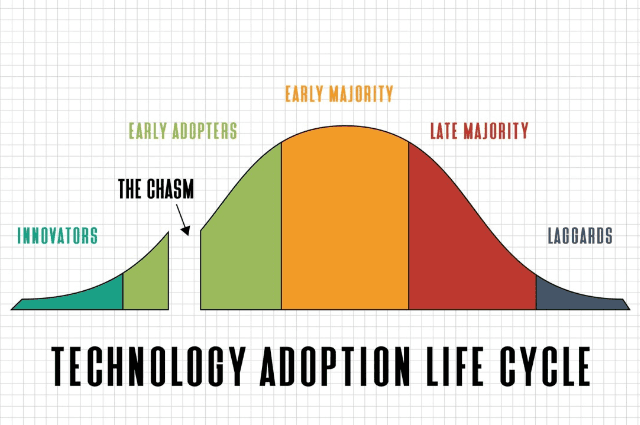
And from the technology adoption point of view, this change is ideal because most consumers won't even notice the difference as, thanks to Apple, they have been paying for things via their smartphone or watch for years already. Trust has already been built. It is only a small step from paying for a coffee via your smartphone, to using that same device to take payments for that new enterprise you've just launched. There is no significant behaviour change demanded of consumers or merchants to use SoftPOS, and the new SoftPOS devices are being designed to look and feel like the old PTS devices to ease adoption further. 'Crossing the chasm' is proving that much easier as a result.
Schemes moving wholesale to MPoC
Simultaneously, the schemes are now shutting down their pilots (which have been running for a whole decade in some cases) and instead insisting that the industry move totally to MPoC. Moving to an industry standard is the last stage of SoftPOS being a generally accepted product by the schemes.
It has taken a while for MPoC standards to come of age. When Version 1.0.1 was launched back in November 2022, it represented a significant unification of SPoC and CPoC into a more flexible, objective-based framework for payment acceptance on mobile/COTS.
However, the publication of Version 1.1 just a year ago, brought vital enhancements around tech flexibility (e.g., modular SDK embedding, non-isolating SDKs); reduced validation burden in certain areas; improved clarity (especially in offline, fallback, detection/response); broader device-type support; and refined self-testing and integration rules—all of which were significant steps forward from our perspective.
More importantly, this evolution signalled PCI SSC's responsiveness to market feedback and its attempt to balance security with practicability. In short, it helped accelerate adoption of the new payments technology, particularly over the last year, and hastened 'early majority' adoption, as Crossing the Chasm's Geoffrey A. Moore termed the start of mainstream adoption of new technology more than 30 years ago. To this end, Mypinpad was particularly pleased to be invited to join the PCI Security Standards Council Board of Advisors back in May.
SoftPOS adoption has created the platform for rapid Tap to Everything innovation on consumer devices
The fact that SoftPOS is well on its way into its Early Majority adoption phase (see figure above) has made it possible for Tap to Everything innovations to be rolled out on consumer devices much more quickly than would normally be the case.
New use cases are likely to be spotted and solutions designed and delivered onto devices/mobile apps in a matter of months now, rather than the years you would have expected before SoftPOS crossed the chasm into mainstream adoption. As a result, we are looking forward to a very busy 2026 and beyond.
Talk to Us
Ready to explore what Mypinpad can do for you?
Certified. Independent. Deployed across 28 countries. Let's talk about your use case.
Get in Touch